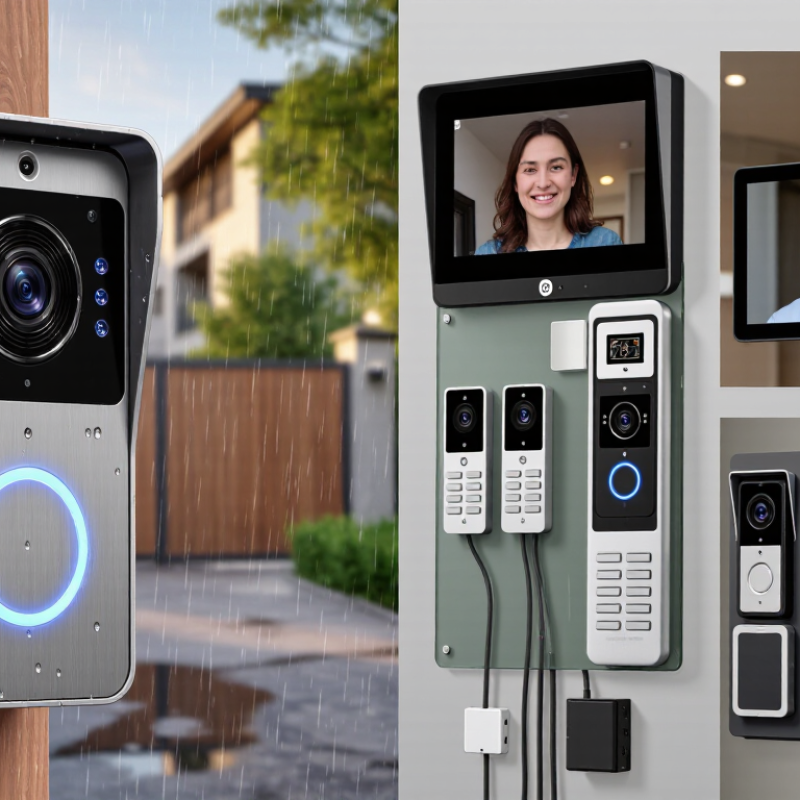
| 2.4 GHz Single-Band Wi‑Fi Door Phone | IEEE 802.11n
Wi‑Fi 4 | 1920 × 1080
H.264, commonly 15–30 fps | Approximately 150–500 ms on a stable local network | At least 2–4 Mbps per active video stream | WPA2-Personal is widely supported; WPA3 support should be verified. More susceptible to interference from Bluetooth, microwaves, and neighboring networks. | Suitable for longer indoor-to-outdoor range and basic residential installations. Choose a clear channel and avoid placing the unit behind metal surfaces. |
| 5 GHz Single-Band Wi‑Fi Door Phone | IEEE 802.11ac
Wi‑Fi 5 | 1920 × 1080
H.264 or H.265, commonly 15–30 fps | Approximately 80–250 ms on a strong local connection | At least 2–4 Mbps per active video stream | WPA2-AES is common; WPA3-Personal may be available. Offers lower congestion but generally has shorter wall-penetration range than 2.4 GHz. | Best for apartments and offices with a nearby access point. Verify 5 GHz channel support and outdoor signal strength before purchase. |
| Dual-Band Wi‑Fi Door Phone | IEEE 802.11n/ac
Wi‑Fi 4/5 | 1920 × 1080
H.264 or H.265, commonly 15–30 fps | Approximately 80–350 ms, depending on band selection | At least 2–4 Mbps per active video stream | WPA2-AES is typical; WPA3 support is preferred. Automatic band selection can improve reliability, but some units require separate 2.4 GHz setup during commissioning. | A flexible choice for global residential buyers. It balances range and throughput and is generally easier to integrate with mixed home networks. |
| Wi‑Fi 6 Door Phone | IEEE 802.11ax
Wi‑Fi 6 | 1920 × 1080
H.264 or H.265, commonly 15–30 fps | Approximately 50–180 ms on a compatible, lightly loaded network | At least 2–4 Mbps per active video stream | WPA3-Personal and Protected Management Frames are preferred. OFDMA and improved airtime efficiency can help in networks with many connected devices. | Recommended for smart homes, offices, and multi-device environments. The access point and client must both support the desired Wi‑Fi 6 features for maximum benefit. |
| Wi‑Fi Mesh-Compatible Door Phone | Wi‑Fi 5 or Wi‑Fi 6
with mesh roaming support | 1920 × 1080
H.264 or H.265, commonly 15–30 fps | Approximately 100–400 ms; wireless backhaul can add delay | At least 2–4 Mbps per active video stream, plus backhaul capacity | WPA2-AES or WPA3-Personal; secure onboarding and unique device credentials are important. Roaming behavior depends on the access point and client implementation. | Useful for large homes, villas, and buildings with weak single-router coverage. Prefer wired Ethernet backhaul where consistent latency is important. |
| Wireless Door Phone with Local Recording | 2.4 GHz, 5 GHz, or dual-band Wi‑Fi | 1920 × 1080
H.264 or H.265; local storage may use microSD or an NVR | Approximately 80–350 ms for live viewing; recording can continue during internet outages | At least 2–4 Mbps for remote live viewing; local recording reduces cloud upload demand | Use WPA2-AES or WPA3-Personal, encrypted storage where available, strong administrator passwords, and automatic firmware updates. Disable unused remote-access services. | Good for privacy-focused buyers and locations with unreliable internet. Check storage endurance, overwrite behavior, timestamp accuracy, and export format. |
| Wireless Door Phone with Cloud Video Service | 2.4 GHz, 5 GHz, or dual-band Wi‑Fi | 1920 × 1080
H.264 or H.265, commonly 15–30 fps | Approximately 300–1,500 ms for remote notifications and cloud viewing | At least 2–4 Mbps upload per active stream; higher capacity is advisable for multiple viewers | TLS-encrypted transport, account-based authentication, two-factor authentication, and signed firmware are preferred. Data-retention location and subscription terms should be reviewed. | Convenient for remote access and multi-user notifications. Buyers should evaluate privacy policies, cloud availability by country, recurring fees, and offline operation. |
| Wireless Door Phone with Ethernet/PoE Fallback | Wi‑Fi 5 or Wi‑Fi 6
plus wired Ethernet or PoE | 1920 × 1080
H.264 or H.265, commonly 15–30 fps | Approximately 30–120 ms over wired LAN; higher when using Wi‑Fi | At least 2–4 Mbps per active video stream | WPA2-AES or WPA3-Personal for wireless mode; 802.1X, VLAN separation, HTTPS, and signed firmware are valuable for commercial networks. | Best for offices, apartment buildings, and security-sensitive sites. Wired fallback improves availability when radio interference or Wi‑Fi congestion occurs. |
| Cellular-Connected 1080p Door Phone | 4G LTE or newer cellular network
with optional Wi‑Fi | 1920 × 1080
H.264 or H.265, commonly adaptive frame rate | Approximately 500–2,000 ms, influenced by signal strength and carrier routing | At least 2–4 Mbps uplink for reliable 1080p streaming | Use carrier-grade encryption, a protected SIM or eSIM, device authentication, private APN or VPN where available, and regular firmware updates. | Suitable for gates, construction sites, remote properties, and locations without fixed broadband. Confirm local frequency bands, data costs, coverage, and regulatory requirements. |
| Battery-Powered Wireless 1080p Door Phone | Usually 2.4 GHz Wi‑Fi
with low-power operation | 1920 × 1080
H.264; motion-triggered or event-based recording is common | Approximately 300–1,500 ms after wake-up; faster response requires the device to remain active | At least 2–4 Mbps during live viewing or event upload | WPA2-AES or WPA3-Personal is preferred. Secure boot, encrypted storage, signed updates, and protection against unauthorized reset are important. | Useful where wiring is difficult. Battery life depends on temperature, signal quality, motion events, live-view frequency, and notification settings. |