





10 Best TV Surge Protectors for Global Buyers?
A modern television is more than a screen. It may connect to streaming services, game consoles, soundbars, routers, and external storage. One sharp voltage spike can travel through the power cable, HDMI line, or coaxial connection. The result may be a frozen display, damaged ports, or an expensive mainboard repair.
The need is measurable. Grand View Research has identified steady growth in the global surge protection devices market, driven by connected electronics and increasingly sensitive equipment. IEEE power-quality guidance also recognizes switching events, lightning-related surges, and temporary overvoltages as practical risks in residential systems. These findings support careful Tvs Surge Protection, not casual reliance on a cheap power strip.
Standards matter. UL 1449 is widely used for surge protective devices in North America, while IEC 61643-11 supports product evaluation in many international markets. However, certification does not guarantee perfect protection in every home. A buyer should check voltage compatibility, joule rating, clamping voltage, response time, maximum continuous operating voltage, and thermal safety features. Cable and antenna protection deserve attention too.
Small details matter.
This guide compares ten TV surge protectors for global buyers, considering outlet design, warranty language, replaceable protection indicators, plug types, and real installation conditions. A model built for 120 volts may be unsafe or unsuitable on a 230-volt circuit. Some products advertise impressive joule figures but provide weak documentation. That deserves skepticism. The final choices balance tested standards, practical usability, and credible manufacturer support, while acknowledging one uncomfortable truth: no surge protector can replace proper grounding or guarantee complete equipment survival.
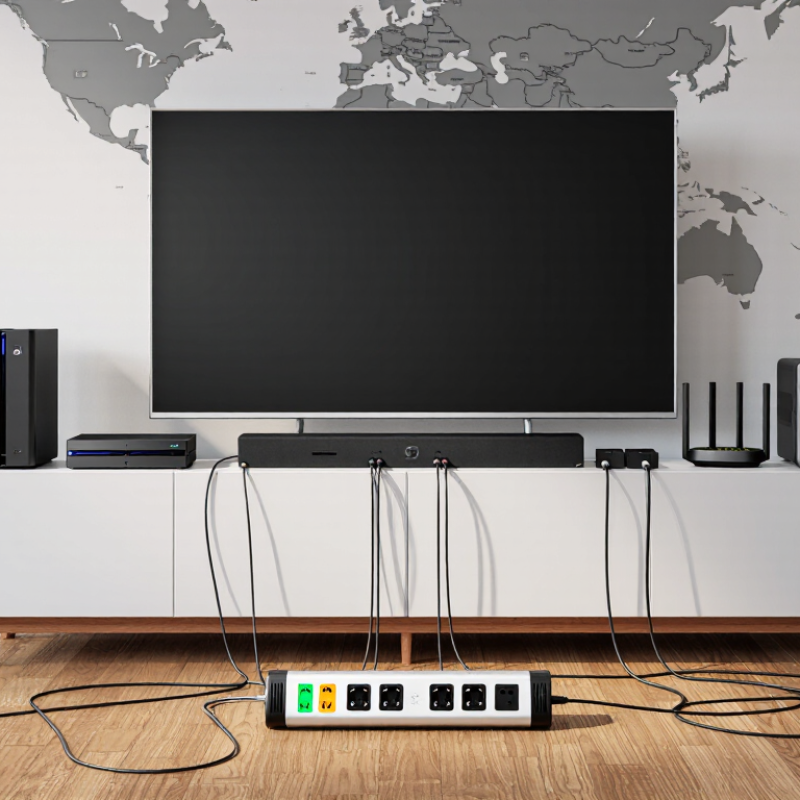
What a TV Surge Protector Is and Why It Matters
What a TV Surge Protector Is and Why It Matters
A TV surge protector is a safety device that redirects brief voltage spikes away from sensitive electronics. Most models use metal-oxide varistors to absorb or divert excess energy. Your television may look protected, but connected devices create additional paths. HDMI equipment, game consoles, antennas, coaxial cables, and network lines can all carry damaging surges. A basic power strip only adds outlets. It may provide little electrical protection.
A suitable protector should match the buyer’s local voltage, plug type, frequency, and safety requirements. Look for recognized regional certification, overload protection, a grounded design, and a visible protection-status indicator. Joule ratings offer useful information, but they do not tell the entire story. Clamping voltage, response time, thermal safeguards, and internal component quality also matter. A higher number is not automatically better.
I once trusted a large joule rating alone. That assumption was too simple. A protector cannot correct low voltage or stabilize an unreliable power supply. It also cannot guarantee safety during a direct lightning strike. Installation matters: connect it to a properly grounded wall outlet, leave enough space around it, and replace it after a serious surge. Some indicators can remain lit even when internal protection has weakened, so inspection is still necessary. For a global buyer, the safest choice is not the most impressive specification. It is the model that fits the local electrical system and the actual cables behind the television.
10 Best TV Surge Protectors for Global Buyers? - What a TV Surge Protector Is and Why It Matters
| No. | Recommended Type | Nominal System Voltage | Plug or Socket Compatibility | Protected AC Outlets | USB Charging | Suggested Minimum Surge Rating | Clamping-Voltage Guidance | Important Safety Features | Global Buyer Checklist |
|---|---|---|---|---|---|---|---|---|---|
| 1 | Basic protection for a single TV | 120 V AC | Type A or Type B systems | 4–6 | Not required | At least 600 J | Prefer a listed value around 400 V or lower for 120 V equipment | MOV-based surge suppression, grounded indicator, thermal protection | Confirm the wall outlet is properly grounded and match the plug shape to the local socket. |
| 2 | TV plus streaming box and game console | 120 V AC | Type A or Type B systems | 6–8 | Optional USB-A ports | At least 1,000 J | Choose a clearly specified UL 1449 let-through rating | Overload breaker, status indicator, spaced outlets for large adapters | Check the total wattage of connected devices and avoid using a plug adapter that removes the earth connection. |
| 3 | Home entertainment setup in a 220–240 V region | 220–240 V AC | Type C, Type E, or Type F systems | 4–6 | Optional USB-A or USB-C | At least 1,000 J | Use a rating specifically designed for 220–240 V circuits | Thermally protected MOVs, overload protection, earth-continuity indicator | Type C, E, and F plugs are not universally interchangeable; verify both plug and socket standards. |
| 4 | TV, soundbar, router, and network equipment | 120 V or 220–240 V AC | Must match the local regional standard | 6–8 | Optional | At least 1,000–2,000 J | Select the correct clamping range for the nominal voltage | Separate coaxial and Ethernet protection, overload breaker, grounded indicator | Cable-line protection must support the actual connector type and data speed; it does not replace proper grounding. |
| 5 | Wall-mounted TV with limited floor space | 120 V or 220–240 V AC | Low-profile regional plug required | 3–6 | Optional side-facing USB | At least 600–1,000 J | Use the manufacturer’s specified rating for the local mains voltage | Low-profile housing, fire-resistant enclosure, visible protection status | Measure the space behind the TV and make sure the protector does not bend the power cord or strain the wall outlet. |
| 6 | Large TV and multiple high-value devices | 120 V or 220–240 V AC | Regional plug with matching grounded socket | 8–12 | Optional USB-A and USB-C | At least 2,000 J | A lower let-through voltage is generally preferable within the correct voltage class | Thermal disconnect, circuit breaker, overload indicator, wide-spaced outlets | A higher joule rating alone does not guarantee better protection; confirm certification, voltage, grounding, and warranty terms. |
| 7 | Regions with frequent thunderstorms | 120 V or 220–240 V AC | Local grounded plug standard | 6–8 | Optional | At least 2,000 J | Use a certified rating appropriate to the local supply voltage | Thermal protection, visible failure indicator, coordinated coaxial protection | No plug-in protector can guarantee protection from a direct lightning strike; unplug equipment during severe storms when practical. |
| 8 | Travel use with a dual-voltage TV accessory | Only when the load supports the local voltage | Regional plug adapter or interchangeable plug system | 2–4 | Useful for low-power charging | At least 300–600 J | Must correspond to the destination country’s mains voltage | Compact enclosure, overload protection, clear voltage marking | A surge protector is not a voltage converter; never connect a 120 V-only device to a 220–240 V outlet. |
| 9 | TV cabinet with USB-powered accessories | 120 V or 220–240 V AC | Local grounded plug standard | 6–8 | USB-C Power Delivery optional; verify output rating | At least 1,000 J | Use a mains rating suitable for the local electrical system | Overcurrent protection for USB ports, thermal protection, power indicator | USB ports may have different output limits; confirm that the charging specification suits the connected device. |
| 10 | Certified protection for international installation | Must match the country’s nominal voltage | Country-specific grounded plug and socket | 4–8 | Optional | At least 1,000 J for general TV use | Look for a published test rating rather than an unspecified claim | Relevant national certification, thermal disconnect, overload protection, protection-status indicator | Look for applicable standards such as UL 1449 or IEC 61643-11, and verify that the certification applies to the exact model. |
The suggested joule ratings and outlet counts are selection guidelines, not guarantees of performance. Surge protectors work only within their rated voltage and electrical environment. For the strongest protection, use a properly grounded installation and consider whole-home surge protection for the building.

