




Top Lab Equipment Stores in 2026 for Global Buyers
Global laboratories are buying more than instruments in 2026. They need dependable delivery, documented calibration, compatible spare parts, and responsive technical support. OECD’s Main Science and Technology Indicators reported a 2.8% increase in OECD-area research and development expenditure in 2022. That growth points to continued investment in research capacity, but it does not make every supplier equally reliable.
A useful Lab Equipment Store should make comparison practical. Buyers should be able to check model specifications, warranty terms, service coverage, and lead times before ordering. A centrifuge that fits the budget may still disappoint if replacement rotors are difficult to source. Small details matter. For international orders, confirm voltage, plug type, shipping conditions, and the documents supplied with the equipment. These checks can prevent delays and avoidable costs.
This guide compares stores serving global buyers, with attention to product range, transparency, support, and purchasing convenience. It draws on publicly available company information and established research indicators, rather than treating promotional claims as proof. Rankings also have limits: service quality can vary by region, and online listings may not show every fulfillment constraint. A careful shortlist is a starting point, not a substitute for checking the details with each seller.
What Defines a Leading Laboratory Equipment Store in 2026
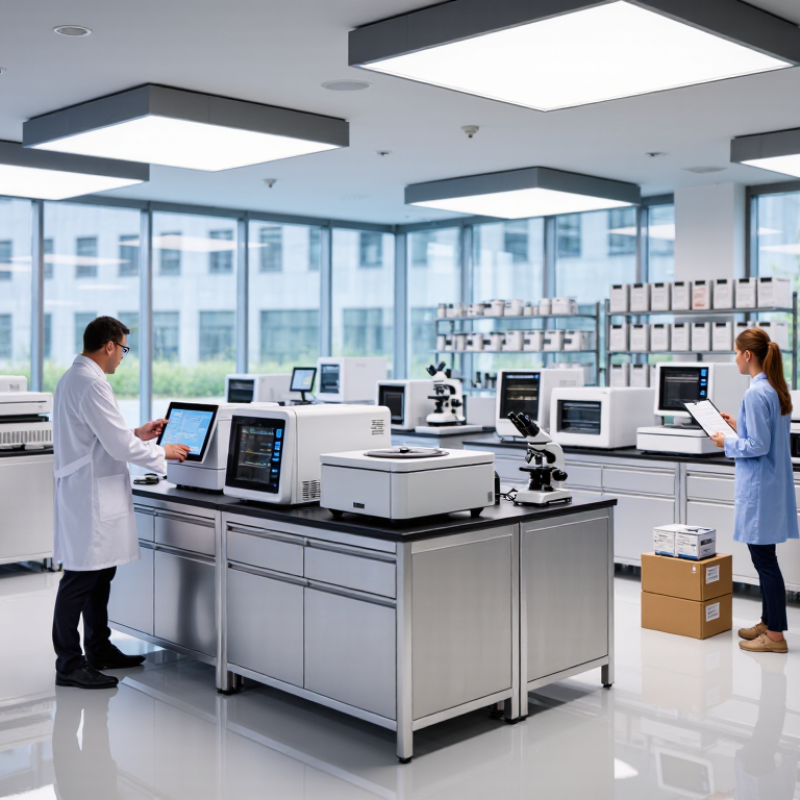
A leading laboratory equipment store in 2026 does more than display centrifuges and balances. It helps buyers judge whether a product fits the work, the room, and the maintenance plan. Grand View Research estimated the global laboratory equipment market at USD 58.4 billion in 2023, with projected growth of 7.4% annually through 2030. That growth makes clear product data essential. Listings should state capacity, accuracy, power requirements, included accessories, and limits of use. Vague specifications waste time.
Trust is built in the details. Buyers need searchable manuals, clear warranty terms, realistic delivery estimates, and access to calibration or repair support. WHO’s Laboratory Quality Management System handbook emphasizes equipment management, including maintenance and calibration records. A store that links those records to specific instruments makes compliance easier to manage. Small details matter. A clear photo of a balance’s leveling feet can answer a real setup question. Yet online descriptions cannot replace a conversation with a technically trained adviser; I would be cautious of any store suggesting otherwise. Global buyers also benefit from transparent shipping terms, spare-part availability, and documentation that travels with the equipment. These are not glamorous features, and they are easy to overlook. That may be exactly why they deserve attention.
Key Criteria for Comparing Global Laboratory Suppliers
Global laboratory buyers should compare suppliers on more than price and product range. WHO’s Laboratory Quality Management System handbook identifies 12 quality system essentials, including equipment, purchasing, documents, and personnel. Ask for traceable calibration records, service intervals, and clear warranty terms. Can the supplier provide a certificate for the exact instrument, not just a general quality statement? Small paperwork gaps can delay installation.
Delivery reliability deserves equal attention. The World Bank’s 2023 Logistics Performance Index assesses six dimensions, including infrastructure, tracking, and timeliness. Use those categories to question suppliers about shipment visibility, packaging, customs documentation, and local service coverage. For temperature-sensitive instruments, ask how transit conditions are monitored and what happens after a missed delivery window. Get the answer in writing.
Compare total operating cost, too. Include spare parts, consumables, training, installation, and expected maintenance—not just the purchase price. Request realistic lead times for commonly replaced components, then check whether local technicians can respond. A polished comparison sheet may still hide weak after-sales support. That is easy to overlook. Review references from laboratories with similar workloads, and verify that quoted specifications match your site’s power, space, and environmental conditions.
Global Lab Equipment Buying: Check Mains Voltage Compatibility
Nominal household supply voltage in selected markets—a practical specification to verify when comparing laboratory equipment for international delivery.
Values shown are nominal: United States 120 V, United Kingdom 230 V, Japan 100 V, China 220 V, and EU countries 230 V. Mains frequency also varies (for example, 50 or 60 Hz in Japan). Confirm the equipment nameplate, plug, frequency, and local requirements before ordering.
Notable Lab Equipment Stores by Region and Specialty
Regional lab-equipment stores often reflect nearby research needs, shipping routes, and service capacity. Buyers in Europe may prioritize calibration records and efficient cold storage. In humid climates, sealed cabinets and locally available replacement parts matter. Small details count.
Specialty-focused stores can help labs compare equipment built for a particular task. For microscopy, check objective specifications, illumination options, and whether replacement components are available. For sample preparation, compare rotor capacity, temperature control, and cleaning requirements. A clear product page helps, but it cannot confirm how quickly support will respond. Ask for written service terms and lead times before ordering.
Global buyers should also examine shipping conditions, installation support, and documentation in a language their team can use. Request current specifications, warranty details, and packaging information for delicate instruments. Check that power requirements suit the destination facility. Listings are not always tidy, and a polished catalog can leave practical gaps. That is worth questioning, especially when a purchase affects daily testing. Comparing regional service options alongside price gives a more realistic picture of long-term value.
| Region | Notable Store Type | Common Specialty | Typical Equipment Available | What Global Buyers Should Check |
|---|---|---|---|---|
| North America | Full-line laboratory supply distributors | Routine research, education, clinical, and industrial laboratories | Balances, centrifuges, microscopes, pipettes, glassware, and general lab consumables | Confirm local electrical specifications, warranty coverage, service availability, and applicable import or safety requirements. |
| Europe | Scientific equipment distributors and specialist suppliers | Analytical science, life science, environmental testing, and regulated laboratories | Analytical instruments, sample-preparation equipment, temperature-control units, and laboratory furniture | Check conformity documentation where applicable, language requirements for manuals, delivery terms, and access to calibration or maintenance. |
| East Asia | Domestic laboratory suppliers and export-oriented equipment retailers | Electronics, materials research, biotechnology, and academic laboratories | Incubators, ovens, water-purification systems, microscopes, and benchtop analytical instruments | Verify instrument specifications, software language, consumable compatibility, export documentation, and the local support arrangement. |
| South Asia | Regional scientific supply stores and institutional procurement vendors | Teaching laboratories, healthcare testing, agriculture, and applied research | Basic lab glassware, balances, pH meters, autoclaves, centrifuges, and educational equipment | Confirm installation needs, spare-parts availability, product documentation, import duties, and whether service is available outside major cities. |
| Middle East | Local distributors serving research, healthcare, and industrial facilities | Clinical diagnostics, oil and gas testing, water analysis, and university research | Water-testing instruments, biosafety equipment, analytical systems, and laboratory cold storage | Check local registration or conformity requirements, climate suitability, cold-chain shipping conditions, and on-site commissioning options. |
| Latin America | Country-based laboratory equipment retailers and import distributors | Food and beverage testing, public health, mining, and academic research | Balances, spectrophotometers, sample-preparation tools, microscopes, and laboratory consumables | Review landed cost, customs documentation, local-language support, voltage compatibility, and the time needed to obtain replacement parts. |
| Africa | Regional scientific suppliers and project-focused procurement channels | Public health, university teaching, agriculture, water quality, and field research | Microscopes, incubators, water-testing kits, solar-compatible cold storage, and basic analytical equipment | Assess power resilience, packaging for transport, installation and training support, consumable supply, and service coverage in the destination country. |
| Global specialist channels | Authorized specialist resellers and laboratory-equipment marketplaces | Chromatography, spectroscopy, microscopy, bioprocessing, and laboratory automation | Application-specific instruments, accessories, replacement parts, and validated configurations | Confirm seller authorization, instrument condition, software and accessory compatibility, calibration records, and cross-border warranty terms. |
How to Evaluate Product Range, Quality, and After-Sales Support
Top Lab Equipment Stores in 2026 for Global Buyers
A broad catalogue is useful only when specifications are clear. Compare measurement range, accuracy, calibration records, consumables, and installation requirements. Ask whether replacement parts remain available after purchase. A low price can hide costly delays.
The OECD’s Government at a Glance 2023 reports that public procurement averaged 12.9% of GDP across OECD countries in 2021. The UNESCO Science Report 2021 puts global research and development spending at about 1.7% of GDP in 2018. These figures show the scale of institutional investment; they do not prove that any supplier offers dependable equipment. Buyers should check certificates, warranty terms, and written service response times. Ask for a sample service record. Small details matter.
After-sales support deserves the same scrutiny as product quality. Confirm who handles troubleshooting, whether remote guidance is available, and how repairs are coordinated across borders. Request realistic delivery estimates for spare parts, not just the instrument. For temperature-sensitive equipment, ask how the seller documents transit conditions. One awkward truth: polished specifications can still leave gaps in everyday use. Have the intended users review the shortlist, then test support with a specific technical question before ordering.
Global Purchasing Considerations: Shipping, Compliance, and Costs
Global buyers should compare the landed cost, not the catalog price. Freight, insurance, customs brokerage, duties, and delivery to the laboratory can change the total substantially. The World Bank’s 2023 Logistics Performance Index assessed 139 economies across six areas, including customs, infrastructure, and shipment timeliness. Use it as a starting point when comparing routes, not as a delivery guarantee. UNCTAD’s Review of Maritime Transport 2024 also reported sharp container-rate volatility, a reminder that quotes can age quickly. Get a dated freight estimate. Delays are real.
Before ordering, ask for the equipment’s country-of-origin documents, electrical specifications, packing dimensions, and any conformity documents required at destination. IEC 61010 is a relevant safety standard for many laboratory instruments, but recognition and additional requirements vary by market and equipment type. Confirm requirements with the local importer or a qualified compliance adviser; a certificate alone may not clear every shipment. For temperature-sensitive instruments, ask how the unit will be protected in transit and whether installation or recalibration is included. Put those costs in writing. A spreadsheet rarely captures every delay, and estimates can miss storage fees or last-mile handling. Keep a contingency in the budget, then verify the final terms before payment.
Related Posts
-
Top 10 Lab Equipment Suppliers for Global Buyers
-
Laboratory Set Up Tips for Optimal Efficiency and Cost Savings?
-

Innovative Solutions for Best Scientific Lab Equipment in Modern Research
-
Exploring Innovative Alternatives in the Best Scientific Lab Equipment Market
-
Unlocking Global Trade Opportunities with Lab Equipment at the 137th Canton Fair 2025
-
Unmatched Excellence in Manufacturing from a Leading Chinese Laboratory Manufacturer