




What Are the Top 10 Laboratory Instruments?
Laboratory Instrumentation turns careful methods into results that researchers can check, repeat, and compare. In a working lab, a micropipette delivers a measured drop, a centrifuge separates a cloudy sample, and a microscope reveals details invisible to the naked eye. These tools are not interchangeable; each supports a different step, and a small setup error can affect the result. Some instruments also need calibration, cleaning, and trained operators. The equipment matters, but so does the person using it.
The market reflects that importance. Grand View Research estimated the global laboratory equipment market at USD 39.2 billion in 2023, with projected growth through 2030. That figure covers a broad market, not just the ten instruments discussed here, so it should not be read as a ranking. Measurement pioneer Lord Kelvin captured the underlying principle: “When you can measure what you are speaking about, and express it in numbers, you know something about it.” A useful reminder. This guide introduces ten widely used laboratory instruments, from balances and pH meters to spectrophotometers and autoclaves. Their order is practical, not definitive; a teaching lab and a clinical research facility may prioritize different tools. The aim is to explain what each instrument does, where it fits, and what users should consider before relying on its readings.
How Laboratory Instruments Enable Scientific Research
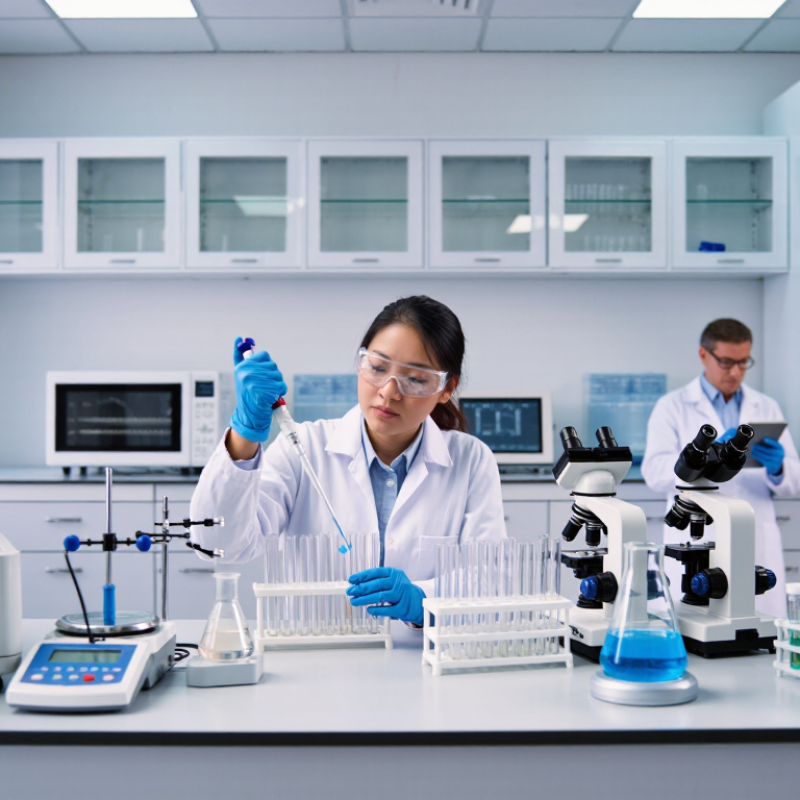
Laboratory instruments turn questions into measurable evidence. A microscope reveals cell structure; a centrifuge separates sample components; a spectrophotometer tracks light absorption. Pipettes and analytical balances help researchers control small volumes and masses. These tools do not make results reliable by themselves. Calibration, maintenance, and careful documentation matter just as much. A drifting balance can quietly distort a whole set of measurements. Small errors travel.
The scale of research makes dependable measurement essential. The OECD’s Main Science and Technology Indicators reported that member countries spent about 2.7% of their combined GDP on research and development in 2022. That investment depends on instruments that produce data other teams can assess and, where possible, repeat. In a 2016 Nature survey of 1,576 researchers, 70% said they had failed to reproduce another scientist’s experiments, while 50% reported difficulty reproducing their own. Instruments are only part of that challenge; methods and training matter too. Still, routine checks—such as testing pipette accuracy and recording microscope settings—can expose problems before they shape a conclusion. Not glamorous. And not always done perfectly. Researchers should also question whether a chosen instrument measures the feature that actually answers their research question.
How to Compare Instruments by Function and Measurement Range
Comparing the top ten laboratory instruments starts with the question each one answers.
Ranges matter. A balance suited to milligram samples may not handle larger containers accurately. Check both its capacity and readability. For a pipette, compare its volume range with the amount actually needed; repeated use near the end of its range may reduce confidence.
A thermometer’s stated range is useful only if its accuracy fits the experiment’s temperature window. Small differences count. Review measurement range, resolution, accuracy, and calibration requirements together, rather than treating them as interchangeable specifications.
For instance, a display showing three decimal places does not prove that the instrument measures accurately to that level. Consider sample size, operating conditions, maintenance, and how results will be recorded. No comparison table captures every constraint; even experienced teams can overlook workflow details when selecting equipment.
Imaging and Analysis Instruments: Microscopes, Balances, and Spectrophotometers
Microscopes, balances, and spectrophotometers help laboratories observe, measure, and compare samples. Each instrument answers a different question. A microscope reveals structure, from cell boundaries to fine particles, while magnification alone cannot confirm what an object is. Lighting, focus, and sample preparation all affect the image. Small details matter.
A balance measures mass, but a steady reading depends on careful setup. Air currents, vibration, and residue on the weighing pan can shift results. Close the draft shield when appropriate, let readings settle, and check calibration according to the laboratory’s procedure. Even a clean-looking pan may need attention.
A spectrophotometer measures how much light a sample absorbs or transmits at selected wavelengths. It can support concentration estimates when the method and reference standard are suitable. Fingerprints, bubbles, or a poorly prepared blank can distort readings. Cuvette orientation matters, too. These instruments are powerful, but not self-explanatory. I find it useful to record settings and sample conditions alongside results; otherwise, a precise number may be difficult to interpret later. Calibration and maintenance records add context, though they cannot replace sound experimental design.
Sample Preparation Instruments: Centrifuges, Incubators, Ovens, and Autoclaves
What Are the Top 10 Laboratory Instruments?
Sample Preparation Instruments: Centrifuges, Incubators, Ovens, and Autoclaves
Reliable sample preparation depends on matching each instrument to the task. A centrifuge separates components by spinning samples at a set speed and relative force. Balance opposing tubes carefully, and check that the rotor suits the tubes and operating conditions. Incubators maintain controlled temperatures for processes such as cell growth or sample conditioning. Even a small temperature drift can affect results. Ovens dry materials or provide controlled heating; they are not interchangeable with incubators. Autoclaves use validated steam cycles to sterilize suitable equipment and materials. Small details matter.
Tips: Record settings, cycle details, and maintenance checks. Avoid overloading chambers, and allow hot items to cool safely. Follow the equipment’s operating instructions.
A common oversight is treating displayed settings as proof that conditions are uniform. Place samples as directed, keep vents unobstructed, and use suitable monitoring where required. For centrifuges, stop operation if unusual vibration occurs; inspect loading and seek qualified support before restarting. For autoclaves, select a cycle appropriate to the load, then verify its performance using the lab’s established procedures. These checks take time. Still, skipping them can make preparation less consistent. Keep a clear record of deviations, even when the cause seems obvious; it may not be.
Liquid Handling and Testing Instruments: Pipettes, Bunsen Burners, and pH Meters
Pipettes, Bunsen burners, and pH meters handle very different tasks, but each can affect a result. A pipette’s displayed volume is not a guarantee of accuracy. ISO 8655-2:2022 defines maximum permissible errors for piston-operated volumetric apparatus, with limits that vary by instrument capacity. Regular calibration and careful tip changes help catch drift. Small volumes matter. A slight tilt or a rushed plunger release can also change delivery, so technique deserves attention.
A Bunsen burner provides a visible, adjustable flame for routine heating, but it needs a clear bench and steady supervision. Keep paper and solvent containers away, and check the hose before lighting. For pH meters, NIST reference data offer useful calibration points: standard buffer values include pH 4.005, 6.865, and 9.180 at 25°C. Temperature matters. A buffer’s value can shift with temperature, so record the temperature and use appropriate calibration settings. Even careful measurements can look more certain than they are.
Tips: Check pipette calibration records before precision work. Rinse the pH electrode as directed, blot rather than wipe it, and allow readings to stabilize. Write down any unusual drift; it may signal a maintenance issue, though it is not proof on its own.
Related Posts
-
Top 10 Lab Equipment Suppliers for Global Buyers
-
Top Biological Lab Equipment Suppliers in China?
-
2026 Best Laboratory Systems for Global Buyers
-
Top 10 Essential Lab Equipment Every Lab Needs
-
Top Lab Equipment Stores in 2026 for Global Buyers
-
Laboratory Instrumentation Showdown: Choosing the Right Tools for Your Research Needs